
Wheel Alignment & Balancing
By Garidoctor Motors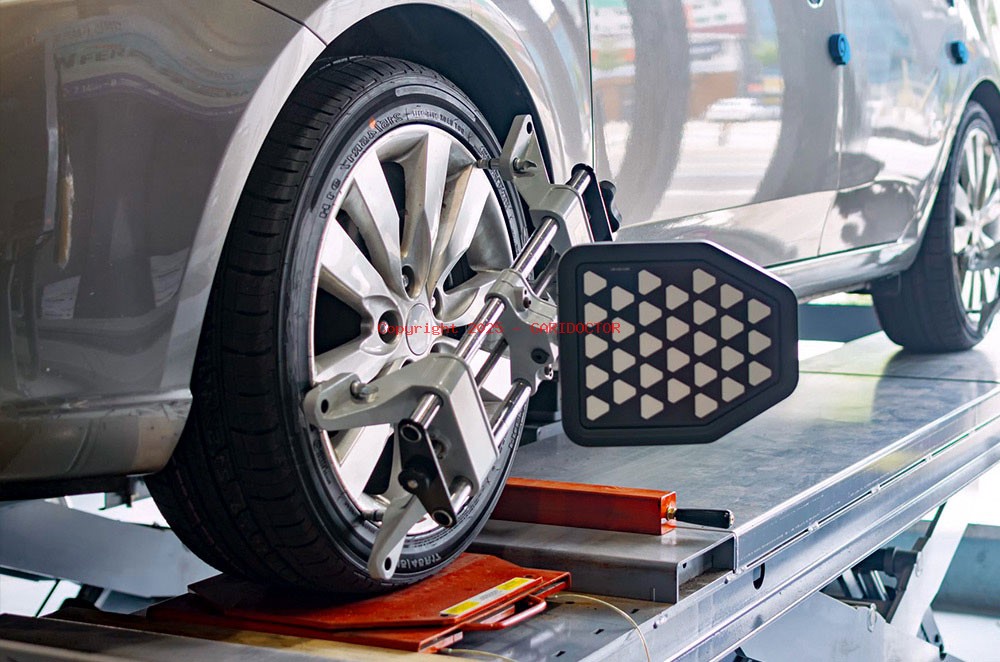
These often confused car wheel adjustment serve different but equally important purposes in the stability and safety of your car.
⚙️ 1. Wheel Alignment (Tracking)
📖 Meaning:
Wheel alignment means adjusting the angles of the wheels so they’re perfectly parallel to each other and perpendicular to the ground.
These angles determine how your car’s tires make contact with the road.
🔧 Main Alignment Angles:
-
Camber:
The inward or outward tilt of the wheel when viewed from the front.-
Too much inward = negative camber (causes inner tire wear).
-
Too much outward = positive camber (causes outer tire wear).
-
-
Toe:
The direction the tires point compared to the centerline when viewed from above.-
Toe-in: Fronts of tires closer together.
-
Toe-out: Fronts of tires farther apart.
Improper toe causes tire scrubbing and feathered wear.
-
-
Caster:
The forward or backward tilt of the steering axis (affects stability and return of steering to center).
🚨 When to Do Wheel Alignment:
-
Car pulls to one side while driving straight.
-
Uneven tire wear (one side more worn).
-
Crooked steering wheel when driving straight.
-
After hitting a pothole, curb, or after suspension repairs.
-
Every 10,000–15,000 km, or once a year as preventive maintenance.
✅ Benefits:
-
Extends tire life.
-
Improves fuel efficiency.
-
Enhances handling and stability.
-
Reduces steering and suspension strain.
⚖️ 2. Wheel Balancing
📖 Meaning:
Wheel balancing ensures the weight of the wheel and tire assembly is evenly distributed around the axle.
Even small weight differences can cause vibration at higher speeds.
🧰 How It’s Done:
-
Tires are mounted on a balancing machine.
-
The machine spins the wheel and detects where weight imbalances exist.
-
Small lead or steel weights are attached to the rim to correct it.
🚨 When to Do Wheel Balancing:
-
Steering wheel vibrates (especially between 80–120 km/h).
-
After fitting new tires.
-
If you feel uneven ride comfort or notice tire cupping.
-
Every 10,000 km or when rotating tires.
✅ Benefits:
-
Smoother ride.
-
Reduces tire and suspension wear.
-
Improves fuel economy.
-
Prevents steering vibration.
🔍 In Summary:
| Feature | Wheel Alignment | Wheel Balancing |
|---|---|---|
| Purpose | Corrects wheel angles | Distributes tire weight evenly |
| Symptoms | Pulling, uneven wear | Vibration at high speeds |
| When to Do | Every 10–15k km or after suspension work | Every 10k km or when rotating tires |
| Tools Used | Alignment rack & sensors | Balancing machine |
| Result | Straight, stable tracking | Smooth, vibration-free ride |
100+
Orders
1M+
Processed
50+
Customers
All day
Support