
What are Control Units (ECUs) and what do they do?
By Garidoctor Motors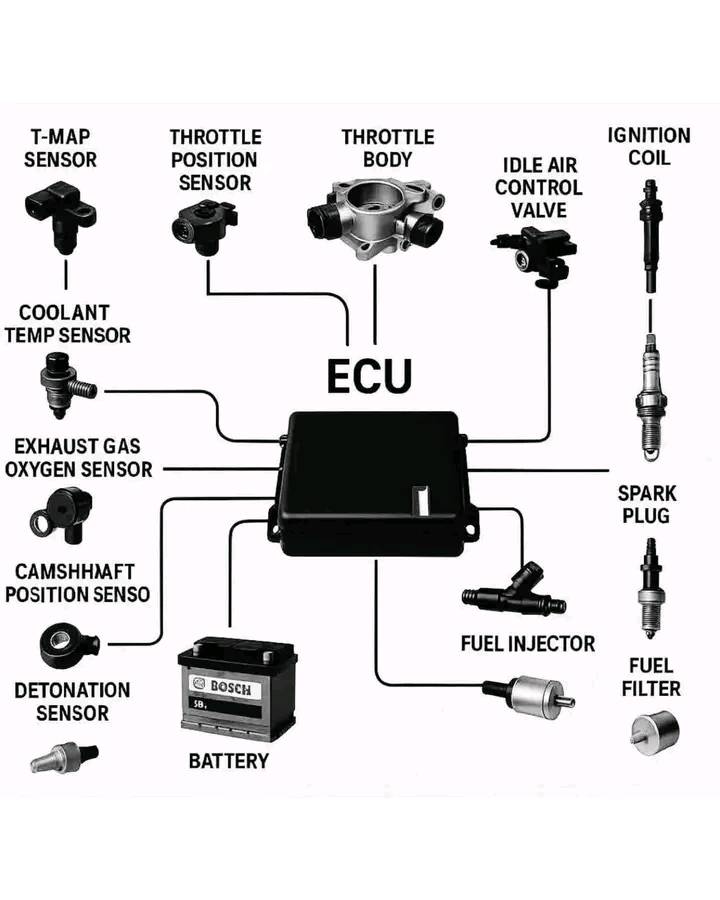
Car control units — often called ECUs (Electronic Control Units) — are essentially small computers that manage and monitor various systems within a vehicle. Modern cars can have dozens of ECUs, each responsible for a specific function or set of functions.
Here’s a clear breakdown 👇
⚙️ 1. What Is an ECU
An ECU is a microprocessor-based device that uses input from sensors (like temperature, oxygen, or speed sensors) to control actuators (like fuel injectors, valves, or fans) in real time.
It ensures the car operates efficiently, safely, and within emission standards.
🚗 2. Types of Control Units and Their Roles
| Control Unit | Full Name | Main Function |
|---|---|---|
| ECU / ECM | Engine Control Unit / Engine Control Module | Controls engine functions like fuel injection, ignition timing, air–fuel ratio, and idling speed for efficiency and performance. |
| TCU / TCM | Transmission Control Unit / Module | Manages automatic gearbox shifting, clutch engagement, and torque converter operation. |
| ABS Module | Anti-lock Braking System Control Unit | Prevents wheel lock during braking by adjusting brake pressure per wheel. |
| ESP / ESC | Electronic Stability Program / Control | Helps maintain stability during skidding by selectively braking wheels or cutting engine power. |
| BCM | Body Control Module | Controls body functions — central locking, interior lights, power windows, wipers, etc. |
| ACU / SRS | Airbag Control Unit / Supplemental Restraint System | Detects impacts and triggers airbags and seatbelt pre-tensioners. |
| ECM (alt) | Electronic Control Module | Sometimes used interchangeably with ECU, or refers to combined control of multiple systems. |
| PCM | Powertrain Control Module | Combines the ECU and TCU to manage both engine and transmission together. |
| EPS / PSCM | Electric Power Steering Control Module | Adjusts steering assist based on speed and steering input. |
| HVAC Control Unit | Heating, Ventilation & Air Conditioning | Manages cabin climate — temperature, fan speed, and airflow direction. |
| Immobilizer / Security Module | Anti-theft system that only allows engine start with the correct key or transponder. | |
| Infotainment Unit | Controls audio, navigation, connectivity, and vehicle interface. |
🧠 3. How They Work Together
All these modules communicate via a network — typically CAN bus (Controller Area Network).
This allows data sharing between systems.
For example:
-
The ABS unit sends wheel speed data to the ECU, which adjusts engine torque for traction control.
-
The BCM communicates with the ECU for keyless start or immobilizer verification.
🔋 4. Why They Are Important
-
Performance optimization (better power and fuel efficiency)
-
Emission control
-
Safety (ABS, airbags, stability control)
-
Comfort and convenience (automatic climate control, power windows, infotainment)
-
Diagnostics — mechanics read ECU fault codes (via OBD-II port) to identify problems.
🛠️ 5. When They Fail
If an ECU or related module malfunctions, symptoms can include:
Check Engine Light (CEL)
Poor performance or misfiring
Transmission stuck in one gear (“limp mode”)
Electrical systems not responding
Airbags or ABS not working
100+
Orders
1M+
Processed
50+
Customers
All day
Support